AI's Copper Wall: The Bottleneck Is Moving From GPUs to the Wires Between Them
Lumilens emerged from stealth with more than $900 million to attack AI connectivity. Broadcom is shipping co-packaged optics; Marvell bought Celestial AI. The next billion-dollar AI infrastructure race is the interconnect, not the accelerator.
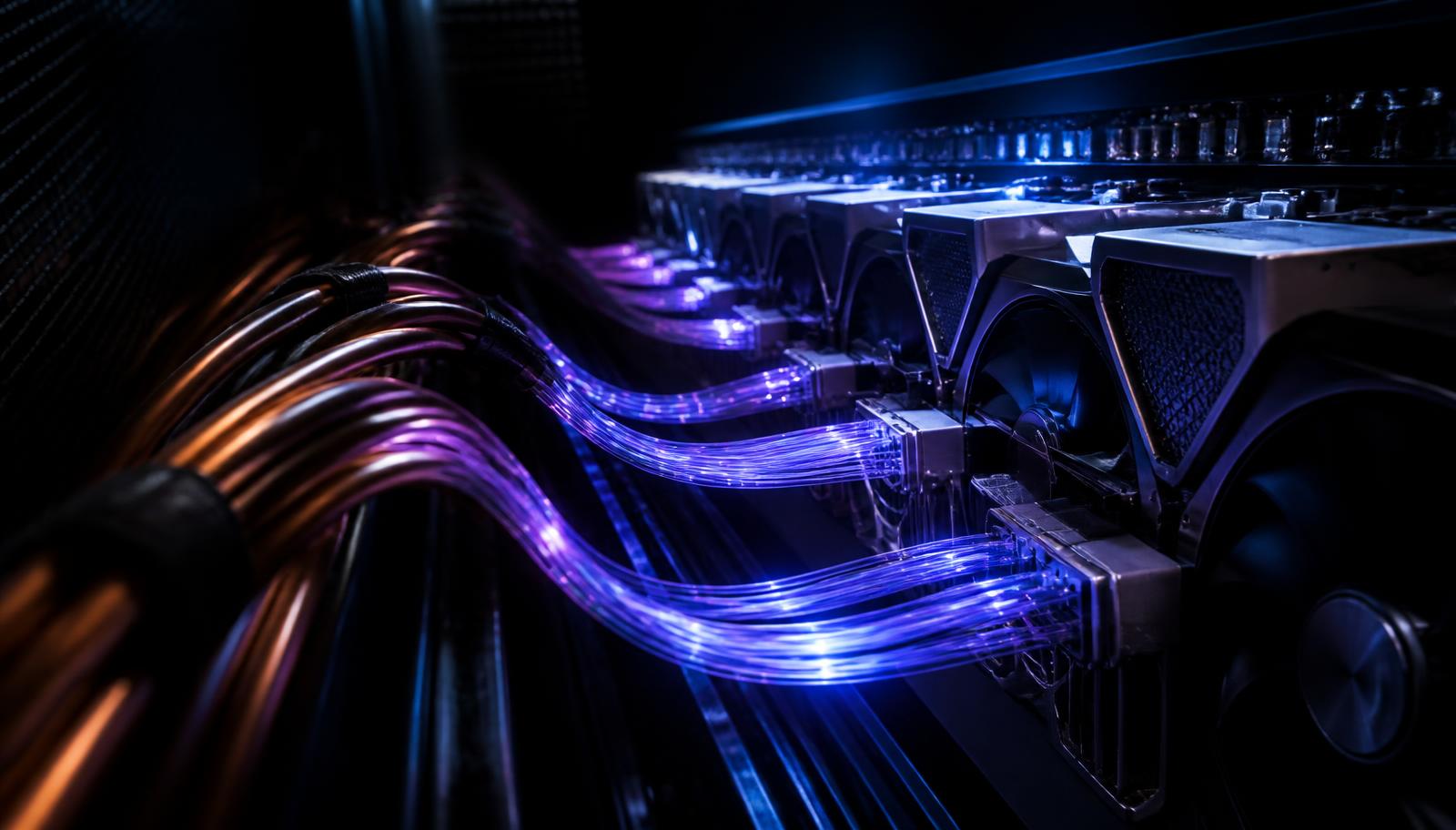
- On 6 August 2026, Lumilens emerged from stealth saying it had raised more than $900 million to attack the AI connectivity bottleneck.
- Incumbents are already moving: Broadcom showed a 102.4 Tbps Ethernet switch with co-packaged optics at OFC, and Marvell closed its acquisition of Celestial AI on 2 February 2026 for $3.5 billion in recorded consideration.
- Modern AI training and inference require hundreds or thousands of accelerators to behave like one machine — and copper is running out of reach, bandwidth density and power headroom.
- Pluggable optics, near-package optics and co-packaged optics are different architectures with different serviceability and thermal trade-offs; the industry is pushing optics progressively closer to the die.
- The metric CTOs should track is not GPU count but accelerator utilisation, bandwidth per accelerator, watts per transferred bit, and ultimately cost per trained or generated token.
For three years the AI infrastructure conversation has been about accelerators: who can get them, how many, at what price. That framing is quietly becoming obsolete. The constraint is migrating from the chips to the links between them, and the capital is following.
On 6 August 2026, Lumilens emerged from stealth saying it had raised more than $900 million to tackle AI's connectivity constraint. That is an unusually large financing event behind a single proposition: connecting accelerators is becoming as strategically important as acquiring them.
Why AI clusters hit a communication wall
A large training run is not one computer doing maths. It is thousands of accelerators repeatedly stopping to agree with each other. Tensor and model parallelism split a single layer across devices. Data parallelism requires an all-reduce over gradients every step. Mixture-of-experts routing sprays activations across the fabric in patterns that are hostile to locality. Inference adds its own traffic: KV cache movement, prefill/decode disaggregation, memory pulled from somewhere that is not the die.
Every one of those operations is a moment where extremely expensive silicon sits idle waiting for data. Once a cluster is communication-bound, buying more accelerators improves nothing. You have purchased more waiting.
An idle GPU is the most expensive object in a data center. Interconnect is what decides how often you own one.
Copper versus optics: what actually changes
Electrical SerDes over copper has been remarkably durable, and it is not disappearing. But copper's problems compound as data rates rise: attenuation gets worse with frequency, so reach shrinks; you need more aggressive equalisation, which costs power; and you need more physical cable bulk to hit the same aggregate bandwidth, which fights you on airflow and mechanical density.
- Reach: copper is fine across a package or a short backplane and painful across a row of racks; optics barely notices the distance.
- Bandwidth density: light lets you multiplex wavelengths on a fibre, so you get far more bits per millimetre of physical escape.
- Power: at high rates, the picojoules per bit spent on electrical equalisation start to dominate; moving the optical engine closer to the die cuts that electrical run.
- Thermals and serviceability: optics near hot silicon is a packaging and laser-reliability problem, which is exactly why this is hard.
Pluggable, near-package and co-packaged are not the same thing
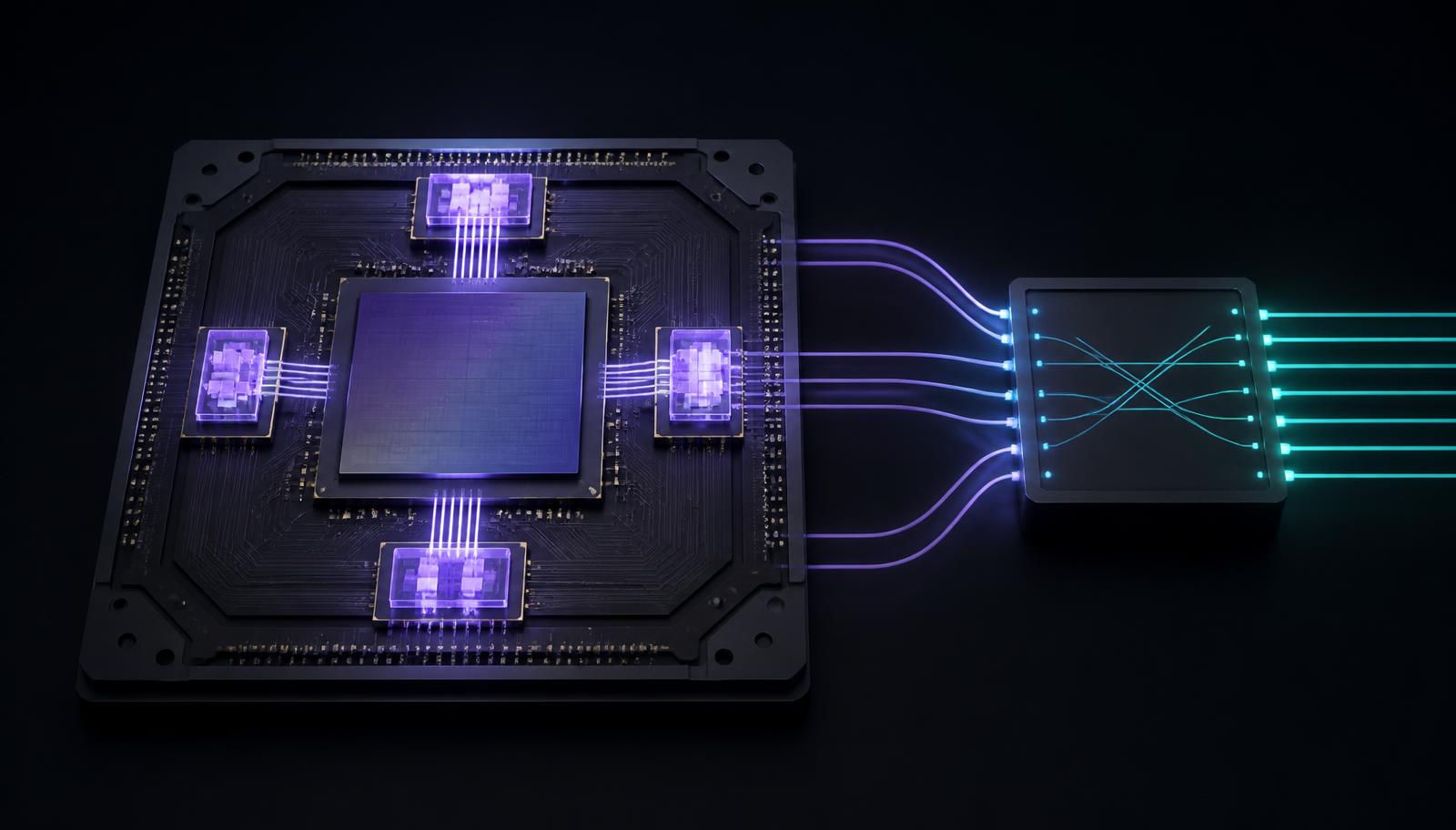
These three terms get used interchangeably in press coverage, and they describe genuinely different machines. A pluggable optical module sits in a faceplate cage: easy to replace, easy to source from multiple vendors, but the signal has to travel across the whole board to reach it. Near-package optics moves the optical engine onto the board close to the switch ASIC. Co-packaged optics puts it on the same substrate as the die.
Each step toward the silicon buys power and bandwidth density and costs you serviceability. A pluggable that fails is a two-minute swap. A co-packaged optical engine that fails is a board. That trade — not raw bandwidth — is the reason adoption is gradual rather than instantaneous.
Silicon photonics becomes part of the compute package
The component list here is worth knowing even if you never touch it: optical engines, modulators, lasers (often external and shared for thermal reasons), photodetectors, optical DSPs, and photonic chiplets that get assembled alongside compute dies. Celestial AI's disclosed first-generation scale-up chiplet was designed to deliver 16 Tbps in a single chiplet and to be co-packaged with XPUs and switches.
Scale-up versus scale-out — the distinction that matters
Scale-up connectivity is what makes a group of accelerators behave like one tightly coupled machine: very high bandwidth, very low latency, memory-semantics-adjacent. Scale-out is the network that connects those groups into clusters and racks. Marvell has explicitly positioned optical technology deeper into scale-up networks, describing the transition as moving optical connections inside racks, systems and eventually packages. Broadcom markets products spanning scale-up, scale-out and scale-across, combining CPO with high-speed optical DSPs, retimers and PCIe Gen6.
The competitive map
- Broadcom: showed a 102.4T Ethernet switch with co-packaged optics at OFC, with a roadmap spanning switching, optical DSPs and retimers.
- Marvell: completed the Celestial AI acquisition on 2 February 2026, with total purchase consideration recorded at $3.5 billion, positioning Photonic Fabric for next-generation optical scale-up.
- Lumilens: emerged 6 August 2026 with more than $900 million raised — a start-up funded at a scale that only makes sense if the buyers are hyperscalers.
- Everyone else: the transceiver and laser supply chain, which suddenly matters strategically rather than as a commodity line item.
What CTOs should measure instead of GPU count
If you procure or operate AI infrastructure, the useful metrics are system-level: accelerator utilisation under real workloads, network oversubscription ratio, bandwidth per accelerator, collective communication latency, watts per transferred bit, and cost per trained or generated token. A cluster with fewer accelerators and a better fabric routinely beats a larger one that spends its life waiting.
When does optical scale-up become mainstream?
Separate availability from adoption. Broadcom already has CPO products on its roadmap; Marvell previously projected meaningful Celestial-derived revenue later in its product ramp. This is an architectural transition measured in product generations, not a weekend in which copper disappears. The direction, though, is not really in dispute — and the money arriving in August 2026 suggests the market agrees.
The next AI advantage will not be bought in units of accelerators. It will be bought in units of bandwidth per watt.
Sources: Lumilens funding announcement (6 August 2026); Broadcom OFC 2026 AI connectivity announcement; Marvell's Celestial AI acquisition announcement and the subsequent filing confirming close on 2 February 2026.
- Loading comments…