Stop Buying AI. Start Fixing Your Business Processes.
Technology isn't your biggest problem — your processes are. A practical look at why business process automation, not more software, is the real unlock for growing companies.

- Most businesses don't have a technology problem — they have a process problem. Buying more AI tools rarely fixes broken workflows.
- Manual work is more expensive than another hire: duplicate data entry, missed follow-ups, delayed invoicing, and burned-out top performers.
- Start small. Automate one repetitive workflow, measure the recovered hours, then compound: sales ops, support, finance, HR, operations.
- AI is powerful, but not always the answer — sometimes a boring deterministic workflow beats a shiny chatbot. Use AI where it genuinely improves outcomes.
Technology isn't your biggest problem. Your processes are.
Businesses everywhere are rushing to adopt AI, chatbots, automation platforms, and the latest software. Yet many continue to struggle with delayed operations, overworked employees, disconnected systems, and expensive manual work.
The reality is simple:
Most businesses don't have a technology problem — they have a process problem.
At Techilla, that's where we start.
Every Business Has Hidden Operational Debt
Imagine a normal day inside a growing business.
- A customer sends an enquiry.
- Someone copies it into Excel.
- Another employee forwards it to the sales team.
- The sales team manually creates a CRM entry.
- A manager sends reminders through WhatsApp.
- Documents arrive through email.
- Invoices are generated separately.
- Reports are prepared manually every Friday.
Now multiply this by hundreds or even thousands of transactions every month. None of these tasks directly generate revenue. They're simply the cost of running inefficient processes.
Manual Work Is More Expensive Than You Think
Many business owners believe hiring another employee is cheaper than investing in automation. It rarely is.
Manual processes introduce:
- Human error
- Duplicate work
- Missed deadlines
- Delayed customer responses
- Lost documents
- Inconsistent reporting
- Higher operational costs
- Employee burnout
- Poor customer experience
Most importantly — your best employees spend their time doing work that software should be doing.
The Problem Isn't Your Team
Businesses often think: "Our employees need to work faster." Usually, they don't. They're simply trapped inside inefficient systems.
Imagine asking someone to:
- Copy information between five applications
- Send the same email fifty times
- Create invoices manually
- Check spreadsheets every morning
- Track approvals over WhatsApp
- Search through email threads for documents
No employee enjoys this work. Technology exists to eliminate it.
What Is Business Process Automation?
Business Process Automation (BPA) is the practice of identifying repetitive operational tasks and replacing them with automated workflows. Instead of employees repeating the same actions every day, software performs those actions consistently, accurately, and instantly.
Automation isn't about replacing people. It's about allowing people to focus on work that actually requires human judgment, creativity, and relationships.
Where Businesses Lose Time Every Day
Almost every organization has hidden automation opportunities.
Sales Operations
Sales representatives manually:
- Update CRMs
- Send follow-up emails
- Schedule meetings
- Create proposals
- Track pipelines
Automation can perform many of these tasks automatically while notifying the right people only when action is required.
Customer Support
Support teams repeatedly answer:
- Business hours
- Pricing questions
- Appointment requests
- Order status
- Service availability
These repetitive interactions can often be handled automatically, allowing support staff to focus on complex customer issues.
Operations
Operations teams spend hours:
- Assigning work
- Monitoring progress
- Chasing approvals
- Updating spreadsheets
- Creating reports
Workflow automation ensures work moves to the right person automatically.
Finance
Finance departments often struggle with:
- Invoice approvals
- Expense processing
- Payment reminders
- Bank reconciliation
- Vendor management
These workflows are ideal candidates for structured automation.
HR
Human Resources teams repeatedly perform:
- Employee onboarding
- Document collection
- Leave approvals
- Offer letter generation
- Offboarding checklists
These processes become faster, more consistent, and easier to manage through automation.
Every Industry Has Different Problems
Automation is never one-size-fits-all. Different industries have different operational bottlenecks.
Real Estate
Instead of manually coordinating buyers, agents, documents, and appointments, automation can streamline the entire property lifecycle.
Healthcare
Patients shouldn't wait while staff manually coordinate appointments, paperwork, and reminders. Automation allows healthcare teams to spend more time caring for patients.
Recruitment
Recruiters shouldn't spend hours reading resumes, scheduling interviews, or updating spreadsheets. Automation reduces administrative overhead while improving hiring speed.
Manufacturing
Production delays often happen because approvals, inventory tracking, maintenance schedules, and reporting remain manual. Automation creates visibility across operations.
Education
Admissions, fee reminders, attendance, scheduling, and communication can all be standardized through automation.
AI Is Powerful — But It Isn't Always the Answer
There's a misconception that every automation project requires Artificial Intelligence. It doesn't.
Many business problems can be solved using deterministic workflows. For example:
- Automatically creating tasks
- Moving information between systems
- Sending notifications
- Generating reports
- Routing approvals
- Updating databases
No AI required.
AI becomes valuable when businesses need to:
- Extract information from documents
- Classify incoming requests
- Summarize long conversations
- Search large knowledge bases
- Interpret unstructured data
- Generate intelligent responses
- Assist employees with decision-making
The best automation solutions combine traditional workflows with AI only where it genuinely improves outcomes.
Automation Should Start Small
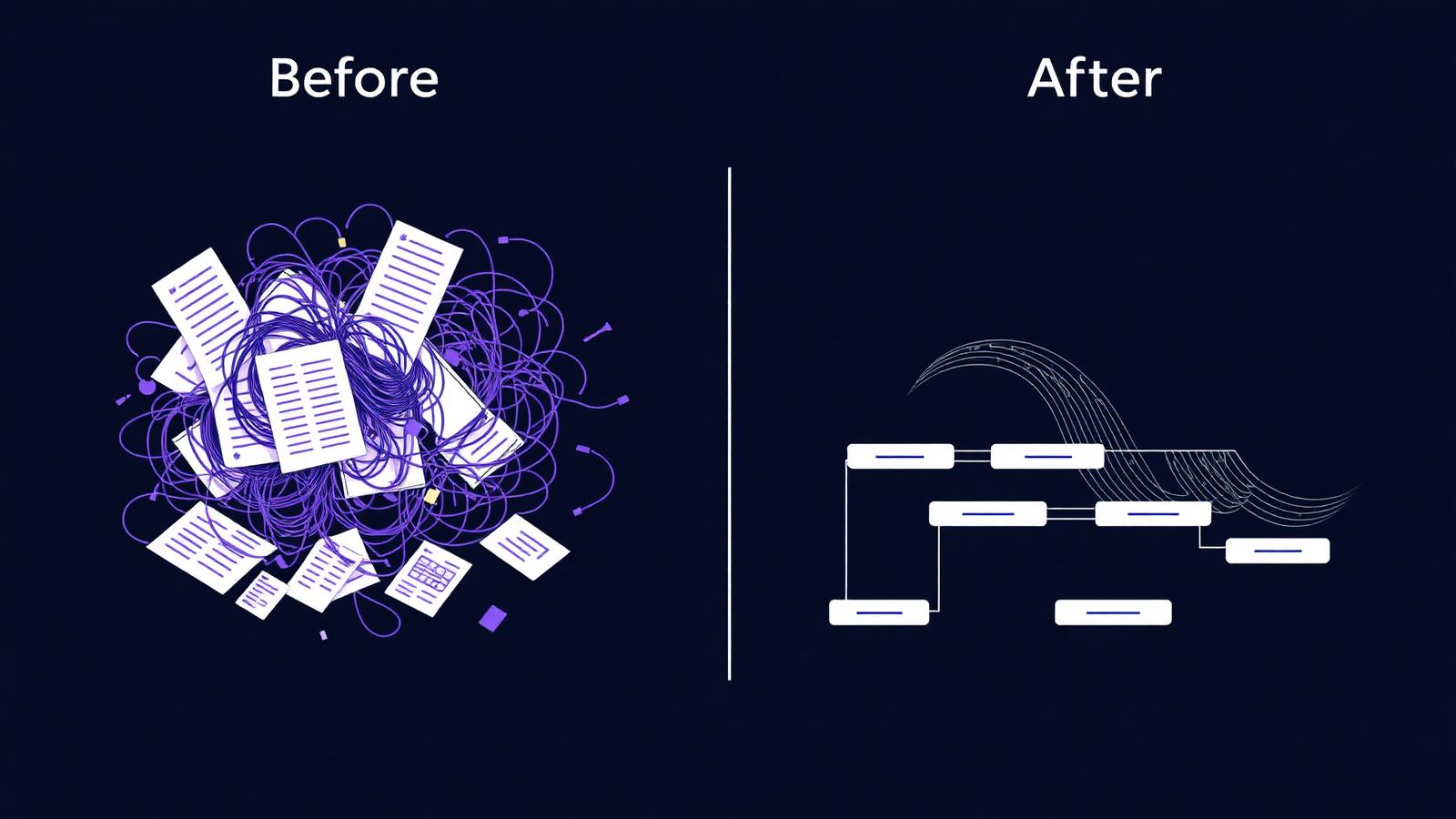
One mistake businesses make is trying to automate everything at once. Successful automation begins with a single repetitive workflow.
Before
- Customer enquiry arrives
- Employee reads it
- Copies details into CRM
- Creates follow-up task
- Notifies sales
- Schedules reminder
- Sends acknowledgement
After
- Customer enquiry arrives
- Workflow automatically categorizes it
- CRM updates instantly
- Correct salesperson is assigned
- Customer receives confirmation
- Follow-up schedule is created
- Manager receives visibility
The business hasn't replaced employees. It has removed unnecessary administrative work.
What Makes Automation Successful?
Technology alone doesn't create value. Understanding the business process does.
At Techilla, we begin by asking questions like:
- Where does work begin?
- Where does information get delayed?
- Which tasks are repeated every day?
- Which approvals slow everything down?
- What requires employees to copy information?
- What generates the most errors?
- Which reports take hours to prepare?
- Which systems don't communicate with each other?
Only after understanding the workflow do we design the solution.
Technology Is the Tool — Not the Product
Many agencies sell AI chatbots, websites, mobile apps, dashboards, and software. We take a different approach. We identify the operational problem first.
Then we determine whether it requires:
- Workflow automation
- Custom software
- AI
- API integrations
- Dashboards
- Internal tools
- Document processing
- Data synchronization
Sometimes the answer is a custom application. Sometimes it's an automated workflow. Sometimes it's simply connecting existing systems together.
The ROI of Automation
Businesses often measure automation by asking: "How much does it cost?" A better question is: "How much is manual work costing us today?"
Consider the hidden costs:
- Employees performing repetitive tasks
- Missed customer opportunities
- Slow approvals
- Delayed invoicing
- Operational mistakes
- Time spent searching for information
- Duplicate data entry
- Reporting overhead
Reducing even a few hours of manual work every week can produce measurable operational improvements over time.
The Future Belongs to Businesses That Scale Their Processes
As businesses grow, manual operations don't scale. Hiring more people to perform repetitive tasks is rarely sustainable.
The businesses that grow efficiently aren't necessarily the ones with the most employees. They're the ones with the best systems. Automation creates those systems.
How Techilla Can Help
At Techilla, we don't sell technology for the sake of technology. We work with businesses to understand how they operate, identify repetitive and inefficient workflows, and implement practical automation solutions that improve efficiency, reduce manual work, and help teams focus on higher-value activities.
Whether it's connecting disconnected systems, automating document workflows, streamlining approvals, building internal tools, or implementing AI where it genuinely adds value, our goal is always the same:
Solve the business problem — not just build another piece of software.
If your team spends hours every week on repetitive work, there's a good chance at least part of it can be automated. Let's identify it together — email hello@techilla.online.
- Loading comments…