Humanoid Robots Just Moved From Pick-and-Place to Whole-Body Foundation Models
Gemini Robotics 2 runs one checkpoint across different robot bodies, controls a humanoid from feet to fingertips and coordinates multiple robots. The real platform war in robotics is becoming vision-language-action models, not robot hardware.
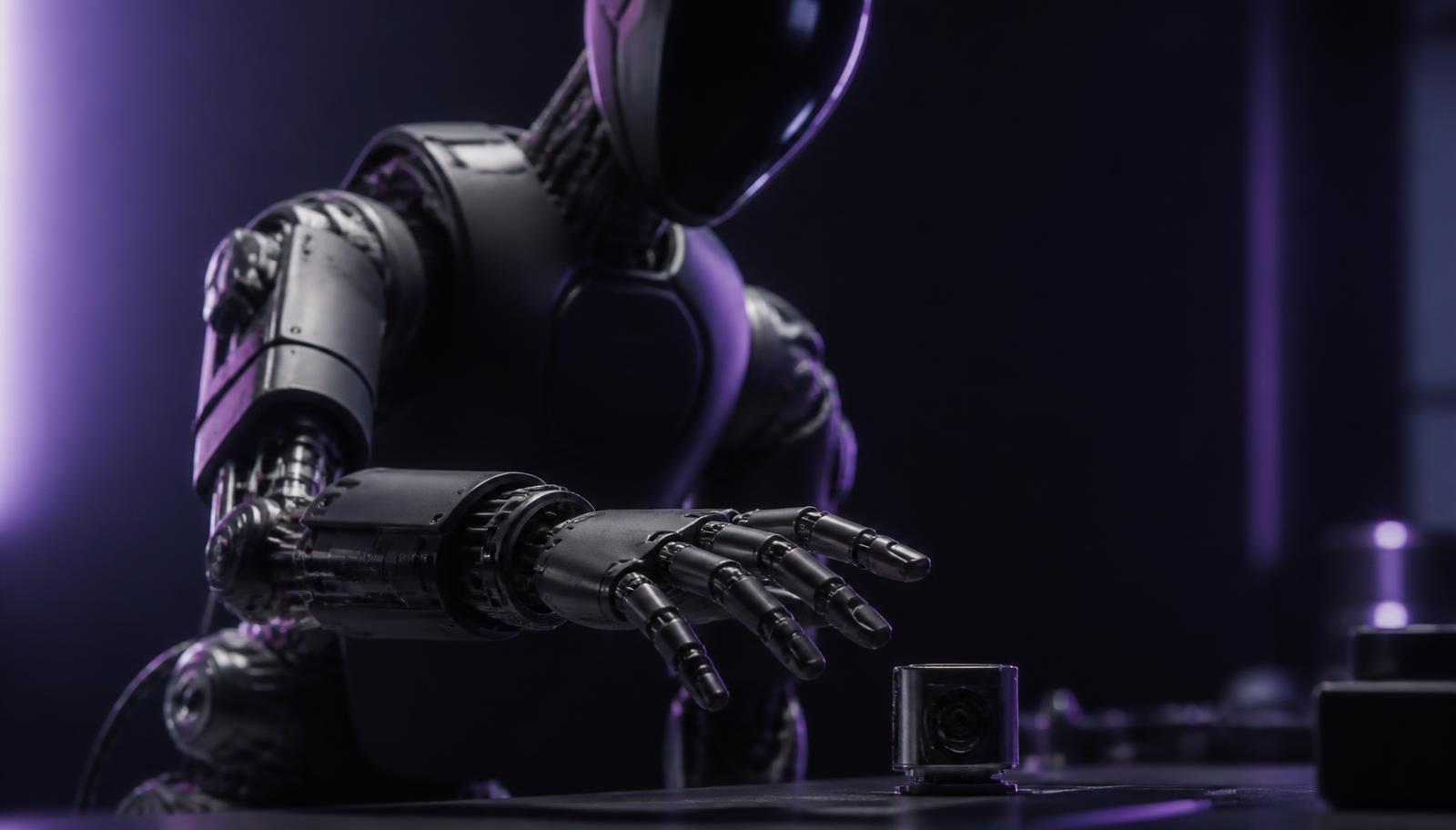
- Google DeepMind announced Gemini Robotics 2 on 30 July 2026, extending its robotics models from tabletop manipulation to whole-body humanoid control.
- The same model checkpoint runs across different embodiments, including an Apptronik Apollo 2 with different hands and a Franka Duo, and can operate a five-fingered 22-degree-of-freedom hand.
- New capabilities include multi-minute task sequences, longer-horizon orchestration and multi-robot collaboration; DeepMind still flags multi-finger dexterity as an open problem.
- NVIDIA's Isaac GR00T stack offers the open, modular counterpart: simulation, demonstration data, policy training, evaluation and deployment onto physical robots.
- The strategic story is that robotics is acquiring a reusable model → data → simulation → post-training → deployment stack, much as language applications did after LLMs.
Robot demos have a credibility problem. A humanoid places a block in a bin, the clip goes viral, and nothing in industry changes. What happened on 30 July 2026 is different in kind, and it is worth being precise about why.
Google DeepMind announced Gemini Robotics 2, expanding its robotics models from upper-body and tabletop work to whole-body humanoid control. The headline capability is not any single task. It is that one model checkpoint is demonstrated across different robot bodies — an Apptronik Apollo 2 with different hands, and a Franka Duo — while handling a five-fingered, 22-degree-of-freedom hand and executing multi-minute task sequences with multiple robots cooperating.
What exactly is a vision-language-action model?
A vision-language model looks at an image and produces text: a description, an answer, a plan. A vision-language-action model takes the same multimodal input and produces something whose eventual consequence is actuator movement. That last step is the entire difficulty. Text can be wrong and get regenerated. A joint command that is wrong puts a robot's elbow through a table.
In practice the stack splits into two layers. High-level embodied reasoning understands the scene, decomposes the goal and tracks progress. A VLA policy converts perception and instruction into low-latency physical actions. DeepMind describes Gemini Robotics ER 2 as the reasoning layer communicating with the VLA — a separation that mirrors how planning and control have always been split in robotics, except both halves are now learned.
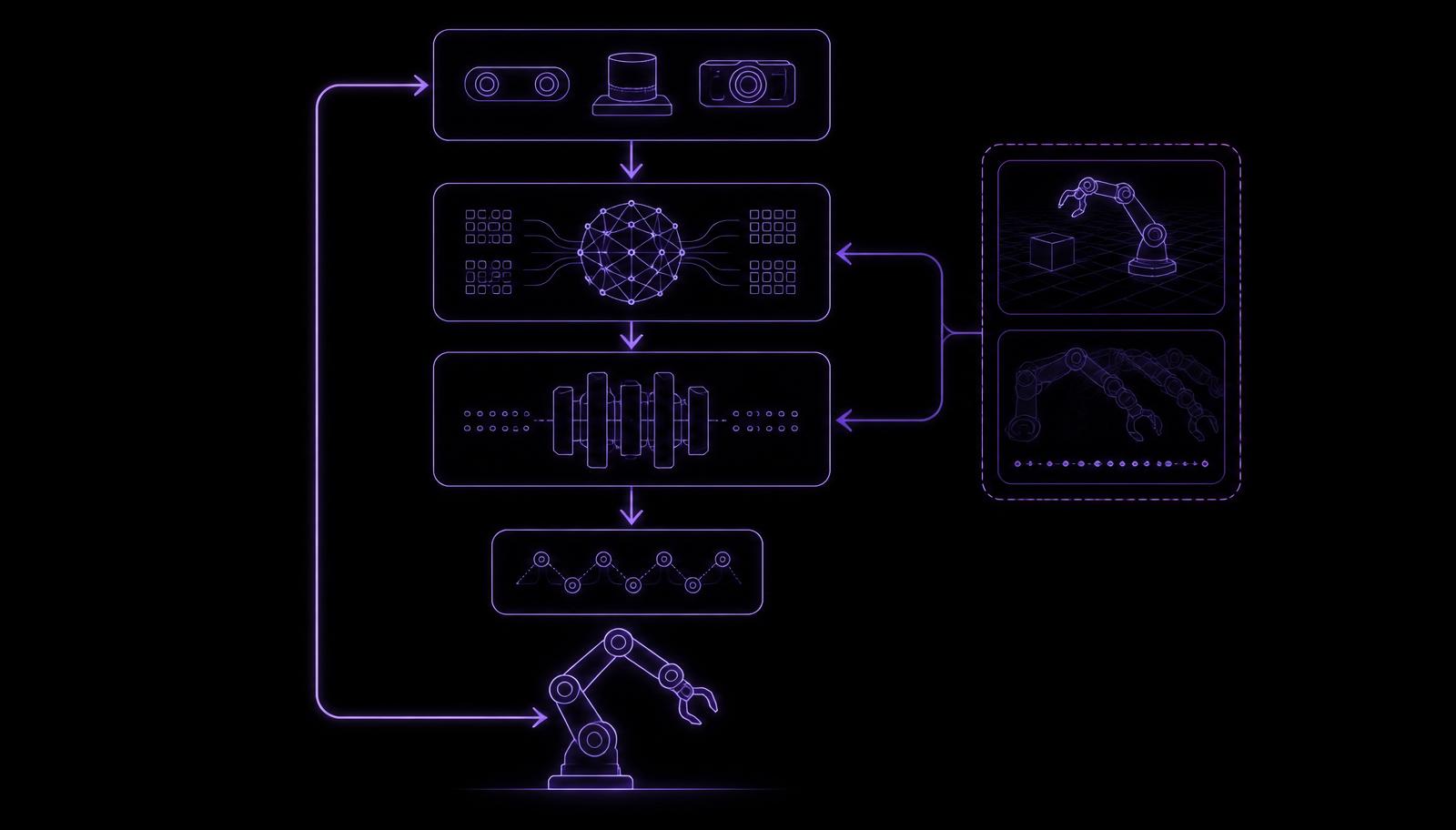
Whole-body intelligence is harder than a tabletop
Once the robot has legs, every subproblem couples to every other one. Reaching for an object changes your centre of mass, which changes balance, which changes the footstep plan, which changes reachability, which changes the grasp you should have chosen. Tabletop manipulation lets you pretend the base is a fixed frame. Whole-body control does not offer that mercy.
One checkpoint, several bodies: cross-embodiment
Historically, robot policies were nearly bespoke. Change the arm, change the gripper, change the camera mount, and you retrained. If one checkpoint genuinely transfers across kinematics, hands and sensor arrangements, the economics invert: the model becomes the durable asset and the hardware becomes swappable. That is precisely the property that turned language models into a platform rather than a product.
Robot data is the new bottleneck
- Teleoperation demonstrations — expensive, high quality, slow to collect.
- Human egocentric video — abundant, but the embodiment gap is real.
- Simulation and synthetic data with domain randomisation — cheap and infinite, with a sim-to-real tax.
- Policy evaluation in simulation before anything touches a real actuator.
NVIDIA's Isaac GR00T workflow is built explicitly around this pipeline: teleoperation, simulation, imitation learning, policy evaluation and deployment. Whoever solves the data flywheel for embodied action will matter more than whoever ships the most photogenic humanoid.
Cloud reasoning versus on-device control
You cannot put a control loop on the far side of a network. The pragmatic split runs along latency and safety lines: slow, semantic, expensive reasoning can live remotely; fast, deterministic, safety-relevant control must run close to the actuators. Connectivity loss should degrade a robot to safe behaviour, not to unpredictable behaviour. Privacy adds a second axis, because a home or clinical robot streaming raw video to a data centre is a policy problem, not just an engineering one.
Google versus NVIDIA is also closed versus open
The more useful comparison is not which robot looks more human. It is Google's model-and-API approach with early-access partners against NVIDIA's modular developer stack across Isaac Lab, GR00T, Isaac ROS and deployment hardware. One optimises for capability behind an interface; the other optimises for a build-it-yourself ecosystem. Both bets have been run before in other parts of computing, and they usually coexist longer than either side predicts.
AI safety is not robot safety
Semantic safeguards — refusing prohibited instructions, recognising people, understanding that a knife near a hand is different from a knife near a cutting board — are necessary and insufficient. Industrial deployment also demands deterministic controls: force and velocity limits, redundancy, emergency stop paths, and certification against established functional-safety standards. DeepMind itself acknowledges remaining dexterity limitations, which is a reasonable reason to read the demos as capability progress rather than production readiness.
The company that owns the robot body captures a manufacturing margin. The company that owns the policy stack captures the platform.
Sources: Google DeepMind, "Gemini Robotics 2 brings whole body intelligence to robots" (30 July 2026); NVIDIA Developer Blog, "Develop Humanoid Robot Policies End-to-End with NVIDIA Isaac GR00T".
- Loading comments…